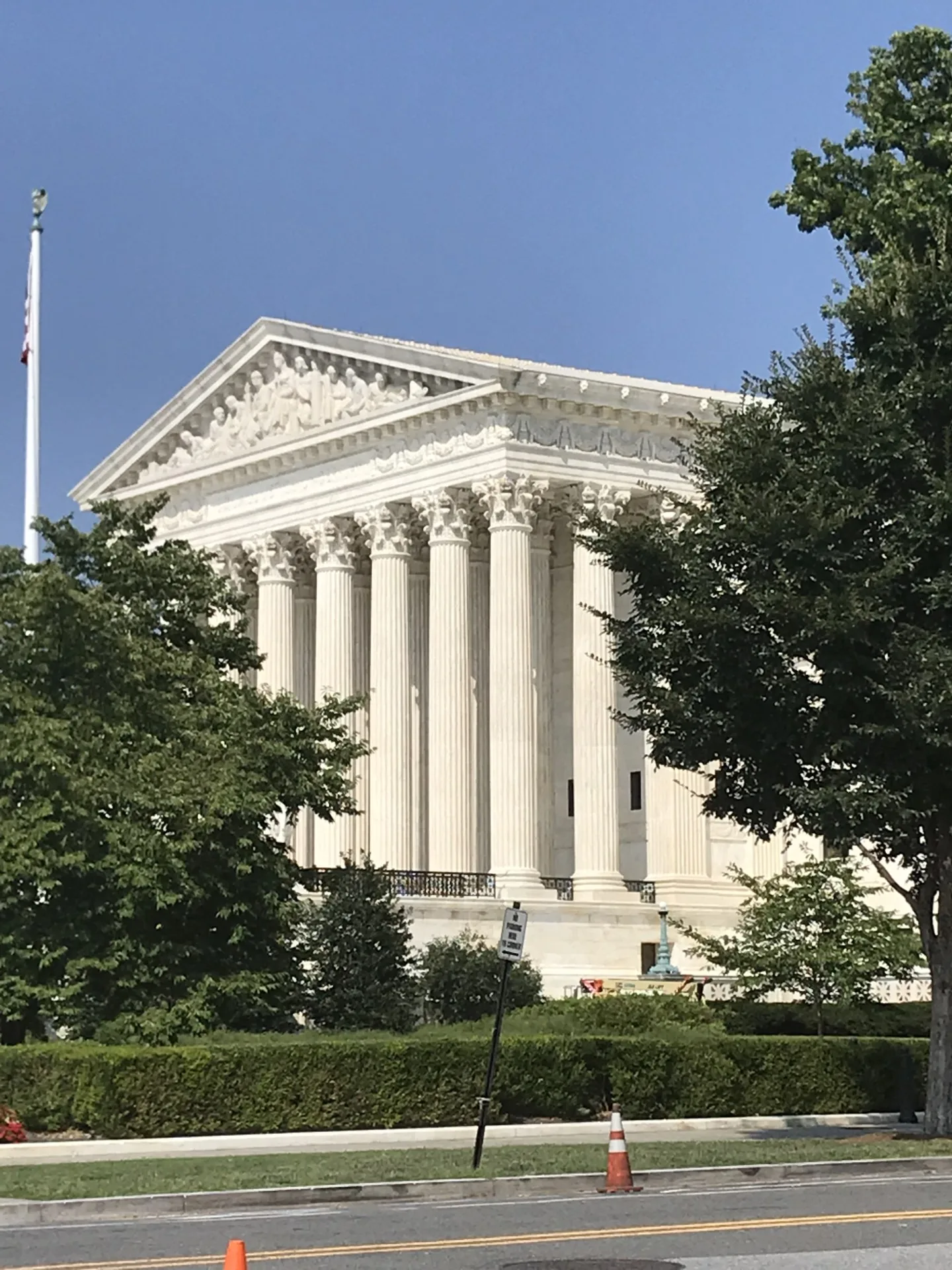
On June 18th, 2026, the United States Supreme Court unanimously decided that the 2nd Amendment of the U.S. Constitution prohibited a prosecution under 18 U.S.C. § 922(g)(3) of an unlawful user of marijuana who simply possessed a firearm in his home in the case of United States v. Hemani, 608 U.S. ____ (2026).
This article will provide a helpful and straightforward overview of United States v. Hemani, including a discussion of its basic facts, the arguments on each side, the Court’s method of analysis, and the impact the case might have as precedent moving forward.
What were the basic facts of United States v. Hemani?
Following the execution of a search warrant on Ali Hemani’s home in 2022 related to an investigation for terrorism-related activities, law enforcement learned that Mr. Hemani possessed a firearm in his home and used marijuana “about every other day.”
This search never resulted in terrorism-related charges, but the government later decided to bring a single-charge indictment against Mr. Hemani for allegedly violating a provision of the federal Gun Control Act on the theory that his unlawful use of marijuana prohibited him from possessing a gun.
The specific charge Mr. Hemani faced was 18 U.S.C. § 922(g)(3), which makes it a federal crime to possess a firearm if you are “an unlawful user of” or “addicted to” a “controlled substance.” If convicted under § 922(g)(3), a person faces up to 15 years in federal prison.
There was no allegation made by the government that Mr. Hemani was a drug addict or that his use of marijuana made him a danger to himself or anyone else. Nor did the government contend that Mr. Hemani ever did anything unlawful with the gun.
Instead, the government’s entire prosecution of Mr. Hemani rested on the theory that his status as an “unlawful user” of marijuana meant he was categorically barred from possessing a firearm under federal law.
How did this case get to the United States Supreme Court?
The procedural history for United States v. Hemani is straightforward.
At the district court level, Mr. Hemani moved to dismiss the indictment, arguing that a prosecution of him under § 922(g)(3) was inconsistent with the 2nd Amendment. The district court agreed and thus granted the motion to dismiss.
The government then appealed to the 5th Circuit, which affirmed the decision of the district court. From there, the government petitioned the United States Supreme Court, which granted certiorari.
What was Mr. Hemani’s argument before the Supreme Court?
Mr. Hemani’s argument was very straightforward, in that he was essentially arguing that § 922(g)(3)’s application to his circumstances was a violation of the Second Amendment based on the framework set forth by the Supreme Court’s 2022 decision in New York State Rife & Pistol Assn., Inc. v. Bruen, 597 U.S. 1 (2022).
What is the basic Bruen framework as applied to a case like United States v. Hemani?
Under the Bruen framework, the analysis in 2nd Amendment cases is simple and requires two steps.
At step one, the court must ask whether the 2nd Amendment’s plain text covers the conduct in question. Clearly this first step was met in the case of United States v. Hemani since the provision at issue categorically prohibited firearms possession by a certain class of people.
Then, once step one is met, the burden shifts to the government at step two to prove that the statute or regulation at issue is “consistent with the Nation’s historical tradition of firearm regulation.”
To satisfy step two, the government must show a “relevantly similar” and “well-established” historical analogue to the provision at issue from the time period surrounding the ratification of the Second Amendment. While this does not require a perfect match or “historical twin,” the historical examples must have a similar purpose and operation to the challenged provision.
It was thus step two of the Bruen framework that was at issue in United States v. Hemani, which meant the entire case came down to a historical analysis of primarily founding-era laws and regulations.
What was the government’s argument before the Supreme Court?
The government attempted to argue that § 922(g)(3)’s prohibition on the possession of firearms by unlawful users of controlled substances (including marijuana) was consistent with the 2nd Amendment.
The government’s argument centered on their claim that § 922(g)(3) was consistent with our Nation’s history and tradition of firearms regulation by citing “habitual drunkard” laws from the founding era and the following decades.
What was the Supreme Court’s decision in United States v. Hemani?
The Supreme Court unanimously ruled in Mr. Hemani’s favor by affirming the judgment below from the 5th Circuit and holding that his prosecution under § 922(g)(3) violated the Second Amendment.
All nine justices agreed in the result. The majority opinion, written by Justice Gorsuch, was joined by Roberts, Thomas, Sotomayor, Kavanaugh, Barrett, and Jackson.
Justice Thomas, writing for himself, filed a concurrence that was focused exclusively on pointing out that § 922(g)(3) also appears to violate the Commerce Clause based on original meaning and precedent in addition to violating the 2nd Amendment.
Justice Jackson, joined by Justice Sotomayor, filed a concurrence arguing that the Court should abandon the Bruen framework and instead analyze 2nd Amendment cases under means-end scrutiny.
Justice Alito, joined by Justice Kagan, filed a concurrence arguing that the Court should have decided the case on narrower grounds.
How did the Supreme Court analyze the issues and apply the 2nd Amendment in the United States v. Hemani case?
Writing for the majority, Justice Gorsuch reaffirmed the Court’s commitment to the Bruen two-step framework in Second Amendment cases.
As mentioned above, step one was clearly met since § 922(g)(3)’s categorical ban on users of controlled substances possessing firearms was clearly covered by the plain text of the 2nd Amendment.
From there, the Court focused heavily on step two, which requires the government to carry its burden of putting forth “relevantly similar” examples of such regulation from the historical record at the time of the founding—which in this case involved exclusively the “habitual drunkard” laws cited by the government.
The Court rejected the government’s step two argument that the “habitual drunkard” laws from the founding era and shortly thereafter were relevantly similar to § 922(g)(3). Central to the Court’s analysis was that the “how” and “why” of the habitual drunkard laws were so substantially and materially different than § 922(g)(3)’s “how” and “why”.
For example, the Court noted that these habitual drunkard laws were not even close to analogous to § 922(g)(3) because they “targeted different kinds of people, did so for different purposes, and operated in different ways.”
After all, many of these habitual drunkard laws targeted people who were so inebriated through alcohol almost all of the time such that they could not manage their own affairs. Obviously, this is not at all similar to someone like Mr. Hemani who uses marijuana on an every-other-day basis.
Moreover, the purpose of these habitual drunkard laws was focused mainly on promoting productivity, removing vices, and upholding certain desired morals among communities. They did not really have anything to do with protecting the public from highly dangerous or violent people—which is purportedly what § 922(g)(3)’s purpose is by categorically barring users of controlled substances from possessing guns.
The habitual drunkard laws also operated much differently than how § 922(g)(3) works. As the Court noted, the habitual drunkard laws usually had some type of pre-deprivation process (e.g., there would be some type of proceeding before you lost any liberties). In contrast, § 922(g)(3) “divests an individual of his constitutional right to bear arms the moment he becomes an unlawful user and until he ends his drug use—all without any pre-deprivation process.”
For these reasons, the government was unable to meet their burden of showing a relevantly similar historical analogues, which thus meant that their prosecution of Mr. Hemani violated the Second Amendment of the United States Constitution.
How narrow is the holding of United States v. Hemani?
The majority opinion expressly states that “in many respects, this case is a narrow one.”
For example, the decision does not squarely address things like:
- Government efforts to ban addicts or those presently intoxicated from having a firearm
- Other prophylactic laws Congress might adopt after determining that users of a particular drug pose a special risk of misusing firearms
- 18 U.S.C. § 922(g)(1)’s provision disarming individuals convicted of felonies from having firearms
- Whether the government could bring a prosecution under § 922(g)(3) with actual proof that a defendant’s use of marijuana (or any other drug) renders him a danger to himself or others (recall that in Hemani, the government did not have any proof of this stuff in his particular case)
At some point, these types of unaddressed issues might very well end up being resolved by the Court. But at least for now they remain open after Hemani.
What is clear from the Hemani holding, however, is that you clearly cannot be deprived of your 2nd Amendment right to possess a firearm simply because you “use marijuana a few times a week” given the lack of a historical record to support such a prohibition.
What are some key takeaways for criminal defendants and criminal defense lawyers following United States v. Hemani?
There are a number of important insights from the Hemani case that both criminal defendants and their attorneys can benefit from when litigating gun possession cases—even if just to preserve issues for appellate review in this rapidly evolving area of law should there be a conviction.
First and foremost, the Court once again made clear that the Bruen test is here to stay. This is good news because it is in many cases a tough test for prosecutors on that second step so long as courts are genuinely holding them to their burden of showing a relevantly similar historical analogue rooted in our Nation’s history and tradition of firearms regulation.
Second, the majority opinion’s focus on the “how” and “why” of the purported historical analogue by the government in Hemani and the statute being challenged in that case certainly provides a useful analytical framework for how defense lawyers can successfully push back on historical analogues that at first glance might appear similar but upon closer scrutiny are substantially different in both operation and purpose to the challenged law.
Third—and quite significantly—Justice Gorsuch’s majority opinion in Section II(C), which focused on “the how” of the habitual drunkard laws versus that of § 922(g)(3), makes clear that even if a historical analogue might justify some form of regulation consistent with the Second Amendment, that does not mean it will justify any form. Thus, if the regulation at issue goes beyond what was permissible at the founding, that could still violate the Second Amendment.
Fourth (and related to the third point above), is that the Court continues to seem interested in the issue of how a lack of a pre-deprivation process impacts these Second Amendment cases. This issue came up in United States v. Rahimi, 602 U.S. 680 (2024) when it came to orders of protection, and so too did it come up in Hemani when the Court examined “the how” of the habitual drunkard laws (which had a pre-deprivation process) versus § 922(g)(3) (which of course did not have a pre-deprivation process). One can thus certainly envision a case in the near future where this issue could become a critical and dispositive issue in a Second Amendment case.
Fifth, it is interesting how many times (5 to be exact) that the Hemani decision highlights the fact that the potential sentence for merely possessing a firearm by someone who uses marijuana regularly is up to 15 years in federal prison and permanent disarmament. In some ways, it seems reasonable to think that this can be read as a bit of a hint that the Court might be open in the future to arguments that even if the government can regulate firearms possession in a certain context to some degree (e.g., licensure, permits, etc.), there might come a point where the penalties related to that regulation are just way too severe to be consistent with the history and tradition framework of Bruen.
For example, if 15 years in federal prison for a marijuana user possessing a firearm seems crazy, is it not even crazier to be subject to 15 years in state prison because you traveled into New York with a loaded firearm that was otherwise lawfully owned (and perhaps licensed) in your home state but just not licensed in New York?
Of course, New York courts have not been all that receptive to Second Amendment arguments post-Bruen in the criminal context, but this is a very rapidly-evolving area of law and the Hemani decision’s reasoning and overall logic certainly seems to be a step in the right direction to providing stronger protection for the Second Amendment rights of all citizens.
Suffice it to say, United States v. Hemani will certainly be a key case for criminal defense attorneys to cite in Bruen motions going forward given that the decision’s overall logic, analysis, and reasoning can be expected to provide strong support for why many gun possession prosecutions are inconsistent with the 2nd Amendment of the United States Constitution.
Final Thoughts
The Hemani decision is an important decision in the ever-evolving landscape of Second Amendment litigation, particularly within the criminal law context. Understanding the reasoning and logic of the Hemani opinion can also help practitioners develop cutting-edge and nuanced legal arguments. For this reason, criminal defense lawyers dedicated to defending gun possession cases can be expected to frequently cite the Hemani case when raising Second Amendment challenges moving forward.
This blog post was written by NY criminal defense lawyer Michael J. McConnell on 6/22/26.
Disclaimer: For informational and educational purposes only. This article is not intended to be legal advice. If you need legal advice, please contact a qualified attorney in your jurisdiction for personalized legal advice based on your unique situation.